Why your cloud map is already wrong
Classic tools can build a hierarchy, but only on clean tags and hand-written rules. Real estates are messy, so the map goes stale. Here is why continuous correlation is the ground floor of resilience.
.png)
July 27, 2026
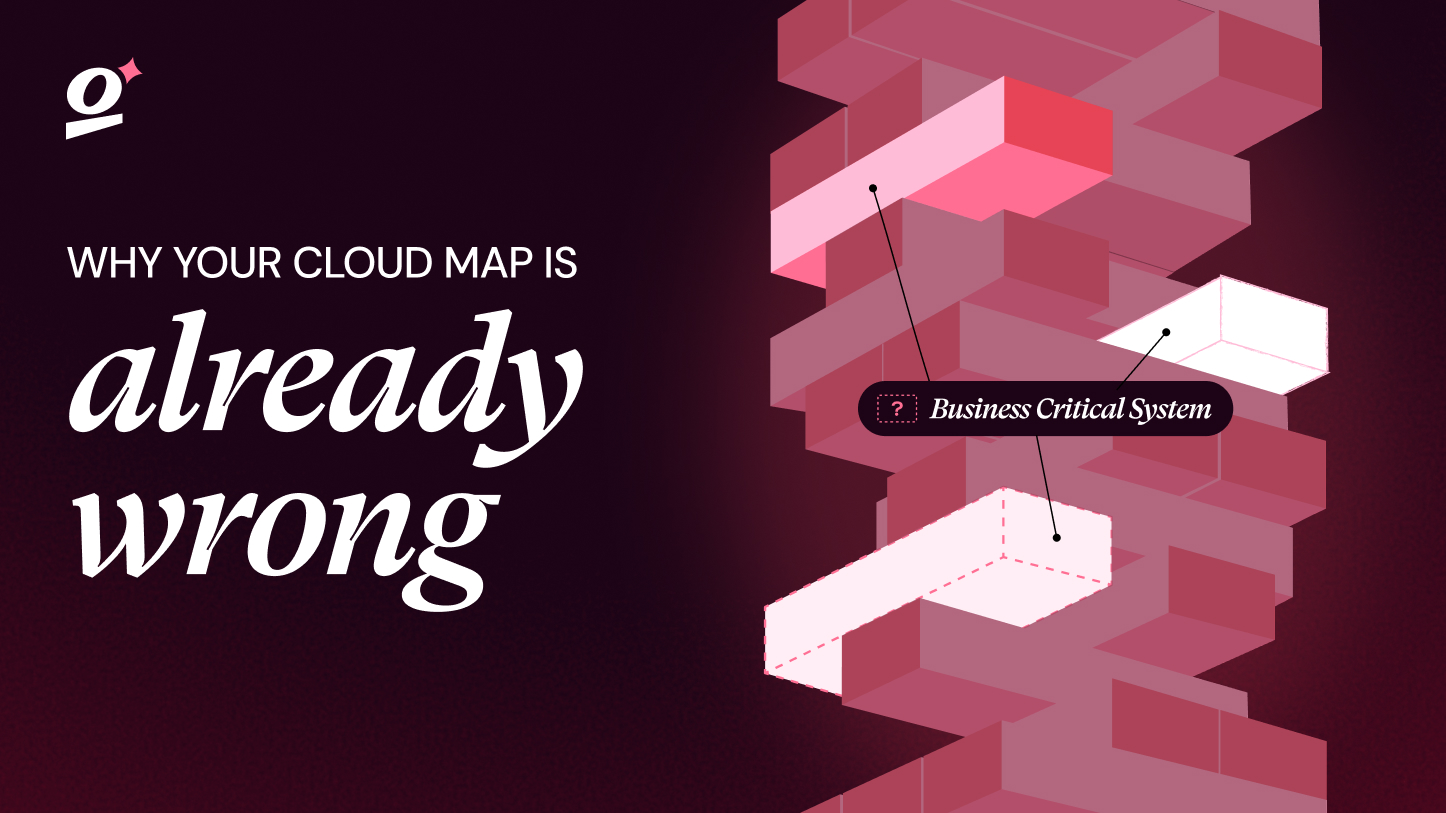
Your cloud this morning is not your cloud tonight. Resources spin up and get torn down, services get rewired, and an AI assistant provisions something over lunch that nobody can describe by dinner. The estate moves faster every quarter, and most teams have quietly lost the thread of what runs the business.
Here is why that matters. Resilience is not managed at the resource level, it is managed at the business level. No one is asked the recovery objective of a single database. They are asked how long it takes to bring the business back, and whether it survives the next incident. Without a live map of your organization, you are blind to those answers.
Plenty of tools can model your estate as a hierarchy, where what you sell sits above what runs it. The catch is how they get there. They ask you to standardize your tags and naming first, then write rules that turn those clean labels into business systems. In a tidy estate, that works. Enterprise estates are not tidy. Many infra and dev teams each bring their own conventions, acquisitions never get reconciled, and labels drift over time. Feed messy inputs into rule-based mapping and one relabel quietly breaks the system it was holding together.
The map you have is already wrong
The usual answer is a mapping project. Companies hire a third party or pull people off their day jobs, interview the business, and hand-draw how everything connects. It runs slow, it costs a fortune, and it produces a snapshot. A full business mapping project can take many months, and in large or complex estates closer to a year, and by the time it lands the environment has moved on.
Most of these efforts never reach a map worth trusting. The CMDB, the traditional home for this record, mostly fails. It has long been cited that around 80% of CMDB projects fail to deliver the value expected, a rate others put as high as 85%. The reason is rarely effort. It is the input. Teams tag resources to show which application they belong to, then rename the scheme six months later. Naming conventions carry meaning until a group invents its own. You end up with a pile of signals, some current, some legacy, and no owner reconciling them. Rule-based tools inherit that mess, because a rule is only as good as the label it reads.
So the honest status of most enterprise maps reads the same everywhere. Slow to build, costly to maintain, stale the moment they publish. That leaves resilience leaders making recovery calls on a picture they already distrust. Naama Etzion showed what that costs when a restored resource turns out not to be a recovered application.
Why is this breaking now, and why is it fixable?
Two forces are colliding. The estate is accelerating, and the tools to keep up have finally caught up.
On the acceleration side, AI has teams shipping more than ever, built faster and tracked less. Wiring one system to another used to take weeks and a change-approval queue. Now it happens in an afternoon, and every dependency in the map moves with it. So the anxiety underneath today's innovation is simple. Nobody has a reliable sense of what they just changed, what a neighboring team changed in parallel, or how any of it lands in the CMDB that is supposed to reflect reality.
On the fix side, none of this was solvable before modern AI. People tried to infer structure with regexes and scans, and it never held up. A map that misses things and mislabels others produces a confident picture that is wrong, which offers false comfort and little else. May Kogan made the same point about recovery, which was computationally intractable until recently. The direction of the field is the same everywhere: away from static, spreadsheet-based analysis, toward a live one that ingests real data and refreshes in days, not months.
Continuous correlation is what makes that real. The approach reads the signals the estate already emits, static ones like tags and naming, behavioral ones like which resource talks to which, what writes where, and what a resource belongs to or is attached to. It does not ask you to standardize anything first. The AI infers the rules from your environment as it is, mess and all, resolving the same application across inconsistent tags and names that a deterministic algorithm would never reconcile. Pair that bottom-up view with the top-down context of what the organization is and what it sells, run it across cloud, on-prem, and Kubernetes, and the map rebuilds itself as the environment drifts.
Mapping is the substrate of Digital Resilience Management
None of the resilience questions leaders get asked can be answered without this map. Blast radius if a resource fails, the choke points worth guarding, what to recover and in what order, which systems must survive which scenario, every one of them is a traversal over a living graph of the business and the technology beneath it.
So this is the ground floor of Digital Resilience Management. Once the map exists and stays current, a resilience objective stops being a guess. You can state the service level you owe customers for a product line, name the resources that are its choke points, and set recovery targets, backups, and retention from evidence rather than a workshop from two years ago. Backups still matter, and this runs alongside the tools you already have. The map is what tells you whether any of it brings the business back.
What comes after the annual mapping project?
The static map is finished as a serious control. An estate that changes by the hour cannot be governed by a document that refreshes once a year. Resilient teams in the next wave will be the ones that see their business wired to their infrastructure, live, and reason over that picture the moment something moves. Visibility like that is becoming the baseline, and the distance between the teams who have it and the teams still hand-drawing diagrams is about to get wider.
For why this is the question boards keep asking, see Joe Ruck on the resilience gap. To see the mapping layer in practice, Gambit builds it as an X-ray of the organization across cloud, on-prem, and backups.
You ask? We answer
It is a model of how your business functions connect to the applications, services, and infrastructure that run them. A good map is directional and shows what depends on what, so you can trace how a failure propagates and what has to come back for a business function to work again.
It can take over the job a CMDB was meant to do. A CMDB decays because it relies on manual updates and static records. A continuously built map stays current by reading the estate directly, so it acts as the living system of record instead of a snapshot that drifts.
Tags help, and they fall short on their own. Teams change tagging schemes, and naming conventions vary across groups, so a tag-only view mixes legacy and current labels. Behavioral signals, like which resources actually communicate, are what keep the picture honest.
It is the discipline of governing whether your business can withstand and recover from disruption across the whole digital estate, not only the cloud. It rests on a live map of how the business is wired, which makes impact, prioritization, and recovery decisions provable instead of assumed.
Both regimes push impact analysis to the business-function level and require mapping critical functions down to their supporting assets. A continuous map gives you that linkage as evidence that stays current, rather than a point-in-time document you re-run under a deadline. See DORA, Regulation (EU) 2022/2554, and the NIS2 Directive (EU) 2022/2555.
.jpg)



Resilience, verified. In your inbox
The latest from Gambit: research, insights, and live sessions