When Digital Outages Disrupt The Real World

November 17, 2026
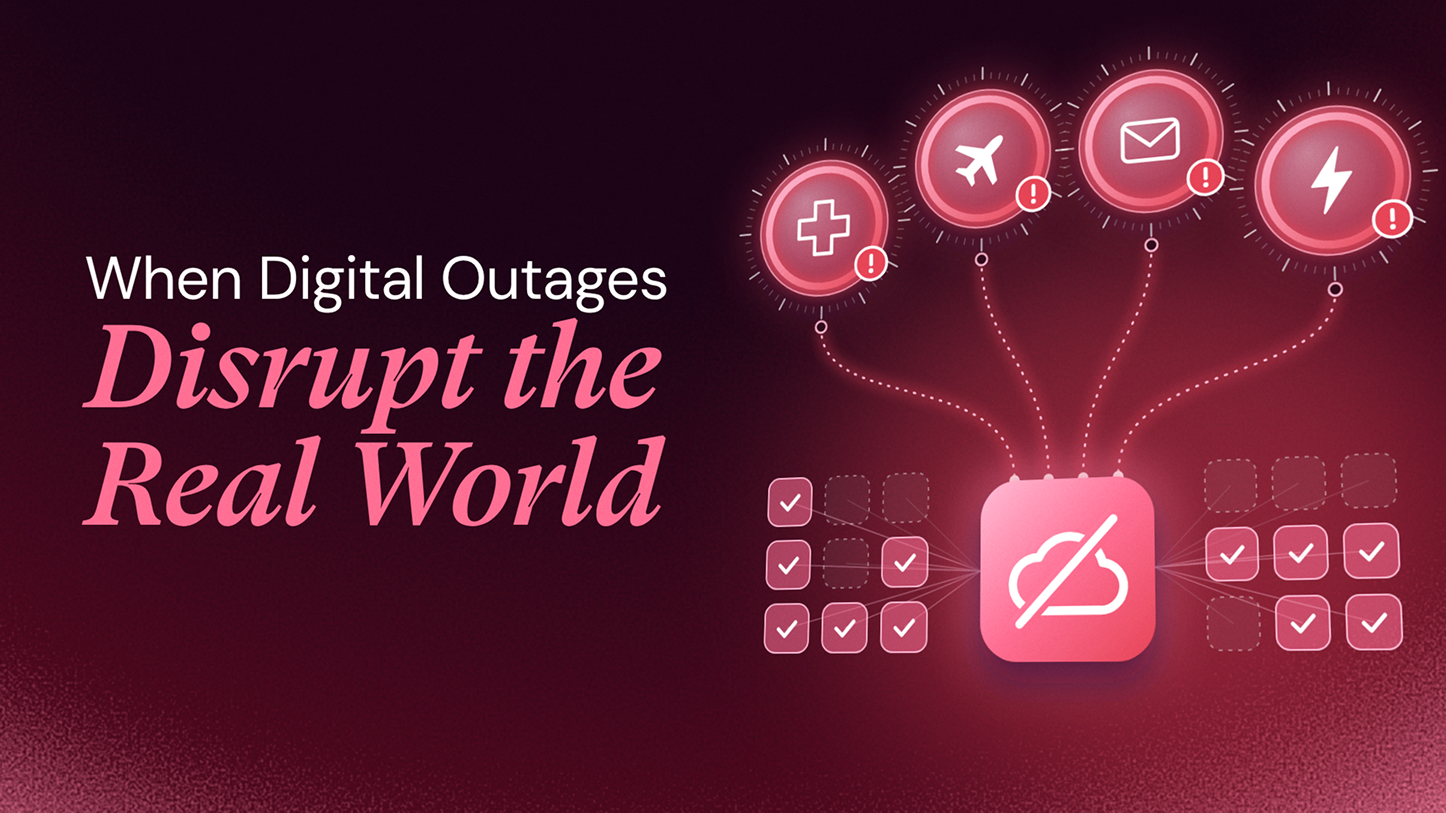
From lost revenue to disrupted healthcare, grounded flights, and public safety incidents, the consequences of digital failures are reaching far beyond the companies experiencing them.
A grounded flight, a delayed medical treatment, a missed safety warning. Increasingly, these are the consequences of software glitches, cyberattacks, and unavailable digital services. As technology becomes inseparable from nearly every aspect of our lives, its failures are reaching far beyond the businesses operating it.
Digital outages are no longer just IT problems or even business problems. Increasingly, they have direct consequences for people's lives, health, and safety.
TL;DR
- Digital outages increasingly have physical consequences. Beyond lost revenue and customer trust, disruptions can delay medical care, ground flights, interrupt essential services, and endanger public safety.
- The biggest risks often lie in unexpected dependencies. As digital infrastructure becomes more interconnected, failures in seemingly unrelated systems can cascade into critical business operations.
- AI is raising the stakes. Faster technological change, accelerated vulnerability discovery, and growing automation make it increasingly important to understand dependencies and recover safely from both unexpected failures and necessary remediation.
- Resilience is becoming both a competitive advantage and a public responsibility. Organizations must go beyond preventing outages to continuously verifying that their critical services can withstand disruption and recover when needed.
Downtime Is Already an Expensive Business Problem
Businesses have traditionally measured outages through lost revenue, recovery expenses, contractual penalties, and reputational damage.
Those costs are substantial. According to the Uptime Institute's 2025 Annual Outage Analysis, more than half of surveyed organizations experiencing significant outages reported losses exceeding $100,000, and one in five reported losses above $1 million.
But the financial damage rarely ends when systems come back online. Customers who cannot complete purchases, access services, or rely on a company's availability may take their business elsewhere. Trust, once lost, can be far harder to restore than infrastructure.
During the September 2023 cyberattack against MGM Resorts, guests experienced disrupted hotel check-ins, digital room keys, payments, and casino operations. MGM subsequently reported approximately $100 million in negative adjusted property earnings impact, while September occupancy fell to 88%, compared with 93% a year earlier, partly due to disrupted booking systems.
But money is only part of what's at stake.
When Technology Failures Become Human Problems
Healthcare: When Systems Go Down, Patients Wait
In February 2024, a ransomware attack against Change Healthcare, a UnitedHealth Group subsidiary, disrupted prescription processing, payments, and healthcare services across the United States.
According to an American Hospital Association survey, 74% of responding hospitals reported direct impacts on patient care, including delays in authorizations for medically necessary treatment.
Months later, a ransomware attack against pathology provider Synnovis disrupted London's NHS hospitals. NHS England reported more than 10,000 postponed appointments and 1,700 procedures across the two most affected trusts.
Aviation: When Technical Failures Ground Flights Nationwide
In January 2023, an outage of the FAA's NOTAM system triggered a nationwide halt to departures. The cause was remarkably ordinary: contractors had unintentionally deleted files while correcting synchronization between primary and backup databases.
Nearly four years later, on November 13, 2026, the FAA experienced another nationwide disruption. This time, routine maintenance caused a cascading telecommunications network failure, destabilizing systems used by air traffic controllers.
More than 10,000 flights were canceled across the United States that day, amid the nationwide ground stop and broader disruptions to air travel. The disruption continued affecting airline operations long after airspace reopened.
Both incidents illustrate how a seemingly routine technical problem can cascade into a nationwide disruption, affecting travelers, airlines, and businesses far removed from the original failure.
Microsoft: When a Missed Email Becomes a Safety Incident
The November 13, 2026 Microsoft outage provides a particularly striking example of an unexpected dependency.
At Phantasialand's Hotel Ling Bao in Germany, a malfunctioning automatic dosing system introduced excessive chlorine into a swimming pool. The hotel's safety monitoring system was designed to warn staff through email. But Microsoft's Outlook outage prevented those warnings from arriving. According to German public broadcaster WDR, 15 guests suffered health effects, and some were hospitalized.
Microsoft's outage didn't cause the dosing malfunction. It prevented the warning from reaching the people who could respond.
One could reasonably argue that a critical safety system should never depend solely on an external email service. But in today's interconnected digital environments, these kinds of hidden dependencies are more common than we might realize.
Modern infrastructure is built from layers of services, integrations, and dependencies accumulated over years. This is hardly limited to small environments. Large enterprises face this problem at an even greater scale, with important business processes often relying on dependencies that were never designed or recognized as critical.
The challenge isn't just preventing individual systems from failing. It's understanding how a failure in one seemingly unrelated system can threaten something much more important.
Energy: When a Cyberattack Forces a Physical Shutdown
In May 2021, Colonial Pipeline suffered a ransomware attack affecting its IT systems. Although the attackers had not been shown to compromise its operational technology, the company proactively shut down its entire pipeline system to contain the threat.
The decision disrupted fuel distribution across the eastern United States, contributing to shortages, panic buying, and emergency government intervention. The Department of Energy coordinated a federal response to help restore operations and mitigate the impact on consumers.
Colonial Pipeline demonstrated that physical disruption doesn't necessarily require attackers to compromise physical infrastructure. Sometimes the responsible response to a digital threat is to take critical operations offline.
As AI accelerates vulnerability discovery and exploitation, organizations may face these difficult decisions more frequently. The recent PHP2Shell discoveries illustrate how rapidly defenders may need to patch, isolate, or temporarily shut down exposed systems.
The ability to remediate threats quickly, without causing uncontrolled disruption to critical operations, will become an increasingly important part of resilience.
Resilience Is Becoming a Competitive Advantage and a Public Responsibility
These incidents span different industries, technologies, and causes. Some were consequences of cyberattacks or the measures taken to contain them. Others resulted from maintenance errors, software failures, or unexpected dependencies on third-party services.
What connects them is our growing dependence on complex, interconnected systems whose failure paths are often poorly understood. A seemingly localized technical problem can cascade through these dependencies, affecting services and people far removed from the original failure.
And as AI accelerates technological change, automation, and the adoption of new digital services, these dependencies will only grow more complex. Technology will continue to improve how we live and work, but its growing importance also raises the consequences of failure.
Organizations cannot prevent every disruption. But they can prepare for it.
That starts with understanding which services are essential to keeping the business operating, what those services depend on, and whether they can be maintained or recovered when something fails. It also means continuously validating resilience as environments evolve, and knowing how to safely change, isolate, or take systems offline when necessary.
This is the mission behind Gambit Security: helping organizations continuously understand their critical business systems and dependencies, identify resilience gaps, and establish confidence that their operations can recover from disruption.
The benefits go well beyond reducing downtime costs. Organizations that can maintain essential services through disruption are better positioned to earn customer trust, protect revenue, and differentiate themselves from competitors. For businesses delivering critical services, the responsibility is even greater.
As our physical and digital worlds become increasingly inseparable, resilience is no longer simply an IT objective or a cybersecurity investment. It's a business necessity, a competitive differentiator, and increasingly, a responsibility to the people who depend on us.


Resilience, verified. In your inbox
The latest from Gambit: research, insights, and live sessions