PHP2Shell Shows the Shrinking Time to Patch

October 22, 2026
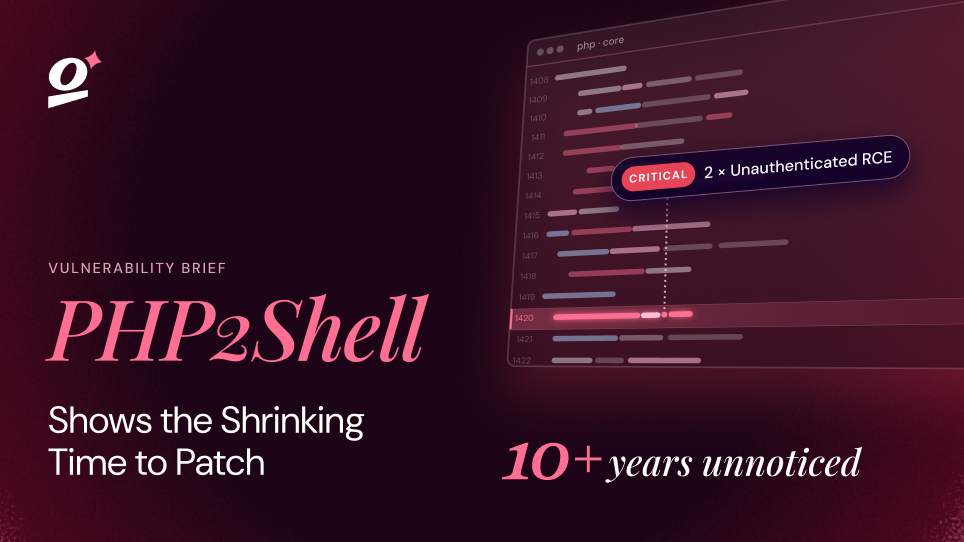
PHP2Shell, the two critical unauthenticated remote code execution vulnerabilities disclosed Wednesday in PHP, had been hiding in one of the Internet’s most widely used software components for more than a decade. Researchers at Calif and Wiz used frontier AI models during the research that led to their discovery and exploitation.
For years, complex vulnerabilities could remain effectively out of reach because finding them, understanding them, and building reliable exploits required extraordinary expertise and time. AI is lowering that barrier.
PHP is used by roughly 69% of websites whose server-side programming language is known. But public websites are only part of the picture, and they’re the easy part to see. Organizations may also have PHP buried inside internal applications, administrative tools, legacy systems, appliances, and workloads that are harder to inventory. That can make the patching and remediation effort substantial.
PHP2Shell is a preview of how much less time defenders are going to have to make the right decisions.
Simple on paper: Patch quickly, and reduce exposure where you can’t.
The response is, on the surface level, simple: identify affected systems and patch them as quickly as possible.
PHP has released fixes for supported versions. Older, end-of-life PHP branches do not receive official security fixes, so organizations running them need to upgrade rather than wait for a patch. Where immediate remediation is impossible, reducing exposure with a WAF, for example, is an important interim mitigation.
Many exposed systems cannot be safely remediated in a heartbeat, and organizations should consider restricting access or taking them offline until they can be upgraded.
Start with the services that impact the business the most
A vulnerability this widespread creates a problem: there may simply be too much to fix at once. Treating every PHP workload equally, doesn’t take business risk into account..
Organizations should start with the Minimum Viable Business - the services and operations that keep the company taking orders, serving customers or paying people. Which PHP-backed applications support operations the company cannot afford to lose? Which are internet-facing? Which contain sensitive data? Which systems do they connect to? What credentials and services can they reach?
A defender needs to think beyond the vulnerable server. When an attacker compromises a web server, they may gain credentials or connectivity they can use to move further into the environment. Organizations should verify that affected workloads are properly segmented, that unnecessary connectivity is restricted, and that compromise of one application cannot automatically become compromise of the systems it depends on.
Don’t restore the vulnerability
There is an issue that’s easy to miss in all that chaos. Imagine patching a critical PHP application today, only to restore it from yesterday’s backup during an outage next month. You may have just restored the vulnerable version of PHP too.
Existing backups remain important, especially for incident response, forensics, and rollback. But after remediation, organizations should establish a fresh, known-good recovery point that includes the patched runtime and validated configuration, taken after the application has been checked for compromise.
The same goes for anything that rebuilds the system. Machine images, container images, IaC templates and deployment code can all pin an older PHP version. Rebuild from any of them, and the vulnerability returns with it.
Sometimes the safest option is to self-disrupt
For critical systems, patching may itself require downtime. Unsupported versions may need a broader upgrade, and systems that cannot be remediated immediately may need to be taken offline or isolated until they can be fixed.
Expect these decisions to become routine. As vulnerability timelines shrink, organizations will be forced to make more rapid and uncomfortable decisions about when to patch, isolate, or deliberately take systems down. Many had to make this decision just recently to patch NetScaler.
Sometimes resilience means choosing disruption on your own terms. If remediation requires taking a critical application down, or if a patch is not yet available and the safest option is to remove exposure, teams need to know the business impact, acceptable downtime, dependencies, and recovery path before they start.
Otherwise, they may bring their own infrastructure down without being able to restore it safely.
There is a meaningful difference between planned downtime you control and an outage an attacker controls.
PHP2Shell is a preview of the AI era
AI is increasing the speed at which defenders can uncover weaknesses that have existed unnoticed for years. The same shift also changes what attackers can realistically discover, adapt, and exploit. We recently unveiled a campaign driven by autonomous AI agents that targeted over 100 organizations in five days, at an average cost of just $25 per target. AI is completely changing the economics of cybersecurity.
Organizations cannot assume that complexity will keep an old vulnerability safe or that they will always have enough time to remediate everything before exploitation begins. They need to continuously understand what the business depends on, where its critical exposure is, how an incident can be contained, and whether critical systems can recover to a safe state.
Gambit helps organizations continuously map those critical business applications and dependencies, identify recovery gaps, and prioritize what matters most.
You ask? We answer
PHP2Shell refers to two critical unauthenticated remote code execution vulnerabilities in PHP: CVE-2026-109618 and CVE-2026-109619, both rated CVSS 9.2. The affected code had existed for more than a decade before researchers at Wiz and Calif used frontier AI models as part of the research that led to their discovery and exploitation.
As quickly as possible. Supported PHP versions have fixes available, while older end-of-life versions may require an upgrade rather than a simple patch. Where immediate remediation is not possible, organizations should reduce exposure through measures such as WAF protections, isolation, or temporarily taking affected systems offline.
Start with business impact. Identify which affected applications support the Minimum Viable Business: the services and operations the organization cannot afford to lose. Then consider internet exposure, sensitive data, downstream dependencies, and what other systems a compromised workload could reach. That gives teams a way to prioritize beyond scanner severity alone.
Yes, alongside anything that can rebuild or redeploy the affected system. A backup or snapshot taken before remediation may contain the vulnerable PHP runtime. Restoring it later can reintroduce the vulnerability even after the production environment has been patched. Machine images, container images, IaC templates, and build or deployment code that references an older PHP version need to be patched as well. If those sources remain unchanged, the vulnerability can return during a future rebuild or restore. After remediation, teams should establish a fresh, known-good recovery point that includes the patched runtime and validated configuration taken after the application has been checked for compromise
When a critical vulnerability cannot be remediated quickly enough and leaving the system exposed creates unacceptable risk. That decision should be made with an understanding of the business impact, acceptable downtime, dependencies, and recovery path. Planned disruption is very different from discovering during an emergency that a critical application cannot be safely taken down or restored.
Because it illustrates a broader change in the vulnerability timeline. AI is making it easier to uncover and operationalize weaknesses that may have remained hidden for years. That means organizations should expect less time between discovery, disclosure, and potential exploitation, and prepare their prioritization, containment, remediation, and recovery processes accordingly.
Gambit continuously maps critical business applications to the infrastructure and dependencies they rely on. It shows teams what matters most, how ready each application is for a disruption, and which fixes to prioritize based on business impact


Resilience, verified. In your inbox
The latest from Gambit: research, insights, and live sessions