

AI agents now break into
online retailers for about $25 each
Find out what stands between a restore and a working business.

Your recovery plan assumes
a slower attacker
against hundreds of online retailers. Here is what we found:
Most break-ins took less than a day.
The cleanup wiped the backups too.
One weak spot led all the way to payment data.
Cheap to launch.
Costly to recover from.
$25
27
600K+
180 Tables
Leave the assessment
with a resilience trategy
Readiness against infrastructure failure, human and AI error, and cyber threats.
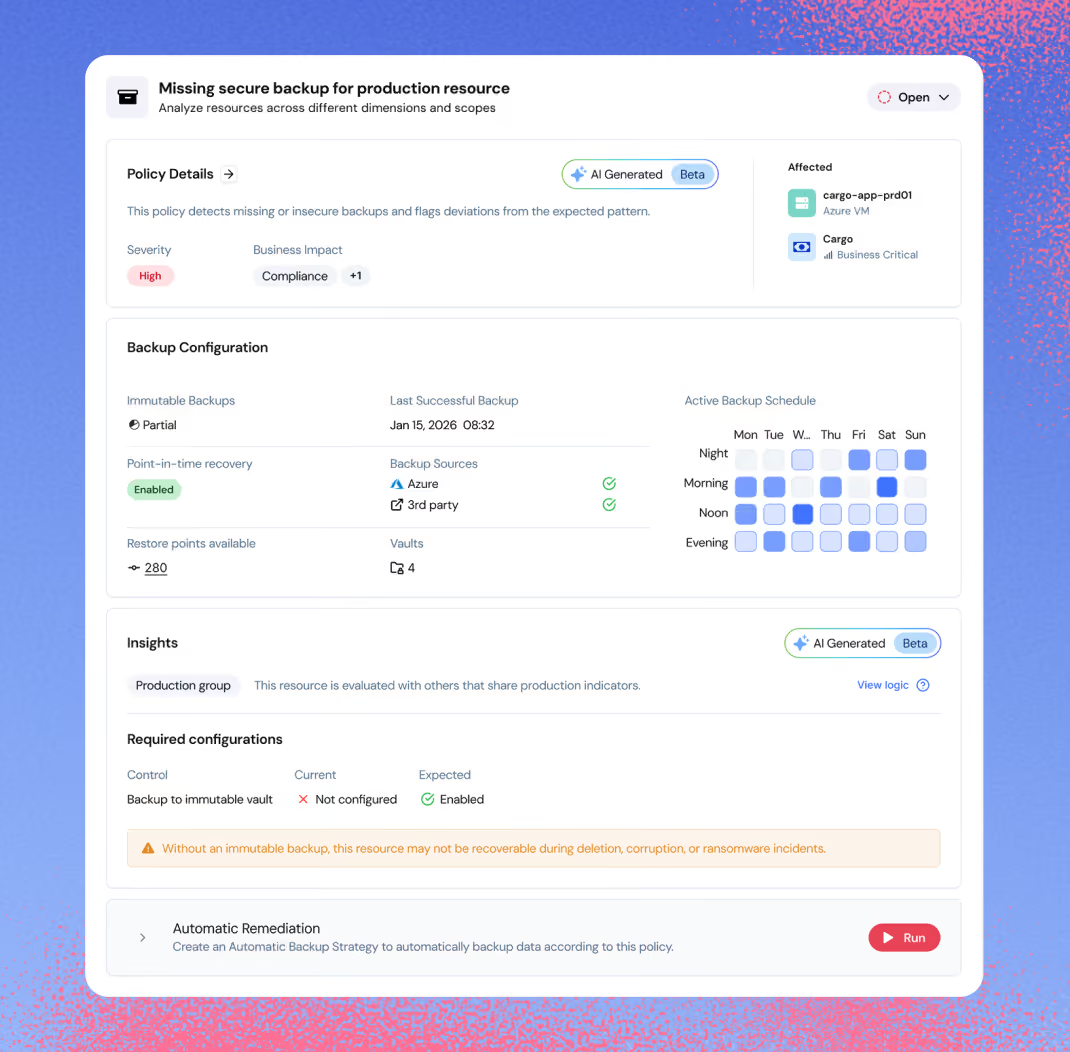
Missing backups, copies that can be deleted, infrastructure nobody can rebuild.
Backups of things that no longer exist, and disks attached to nothing.
Mapped to NIST 800-53, SOC 2 and SOX. DORA with the setting that drew the flag.
Connect one environment
in fifteen minutes

You pick
the accounts

You provide us read‑only access to metadata

We map your business applications & score them

Get your Resilience Posture Readout
Questions
A read-only look at metadata in part of your live environment. You pick a few cloud accounts. We work out which business applications run in them, what each one depends on, and whether it would come back after an outage or an attack. Fifteen minutes to set up. Findings five days later.
Anything that stops your systems running. A ransomware attack, a cloud provider outage, a failed migration, an AI agent making a change nobody reviewed, a misconfiguration nobody noticed, or an employee deleting the wrong thing.
No. The research followed attacks on online retailers, and the same tools work against most companies with a web app and a database. The assessment also covers disruption with no attacker behind it: a cloud outage, a failed migration, an AI agent making a change nobody reviewed, or an employee deleting the wrong thing.
You get a 30-minute call within one business day. On it we pick the accounts, answer your security team's questions, and work out who needs to approve the access. Nothing connects to your environment until after that call.
Nothing. The findings are yours whether or not you go further.
No, and be careful of anyone who says theirs does. Running a full recovery at enterprise scale is not something we do, or anyone else. What this does is check your recovery assumptions against your live environment and tell you which ones do not hold. That is the gap most plans die in.
Less than you would think. Two or three accounts produce findings worth having. Start where the revenue is. Widen later, once you have seen them.
Find out what your business can bring back after an attack like this.
We map and score your recoverability across cloud, IaC, and backups.